Tuesday, August 6, 2013

Trayvon in Bolivia: being attacked on the streets I call home


Trayvon Martin
in his hoodie with Skittles
& Arizona Tea (a menace).

While the expectations of
Bolivian women are often
that they make great sex
objects, that they should
leave men alone when men
want to party and drink, and
meanwhile clean and raise
children, in the US our expec-
tation of black men is that
they are threats, lazy, and
"should learn to be, act, and
dress more like successful
white people" if they want
to be better and well-
adjusted human beings.
Oppression has much to do
with EXPECTATIONS of
what you are or should be.
This MISS BOLIVIA photo
obviously demonstrates a
perspective of  ideal "woman."
Recently a similar photo was
side-by-side with an article on
pregnant teenager girls being
expelled from their villages
or beaten, because of the
"bad example" they set as
victims of rape.
Yes, beating rape victims in
front of the village and their
families, then burning the
fetus in front of the girl's eyes.
So...what is the ideal Bolivian
woman supposed to be?
I won't pretend to understand the daily plight of being a black man in North America.  However, a year and a half in Bolivia has given me—as I naively hoped in would—some experience of being a minority, even of being oppressed. 

Granted, I certainly receive the benefits of my white skin and gender.  I can walk into a cafe and use the bathroom, without anyone first demanding, "If I'm going to buy something or not."  That wouldn't fly with an indigenous cholita.   While walking a hot mile in the sun on a blockaded highway, a trucked graciously picked up my white companion and I, though we were carrying very little cargo, and charged us nothing for the lift.  The same truck zoomed by indigenous grandmas with heavy loads on their backs, the driver's generosity reserved for the "privileged class."  Differing from the discriminatory experiences noted last week by Barack Obama, no one "locks their car doors as I walk by" or "follows me in department stores" (ok, full disclosure, I've never been in a Bolivian department store).  However, I have come to know the daily anxiety of passing down the street--awaiting stares, whistles, catcalls, physical sexual harassment or violence.  Before my time in Bolivia, never before had I experienced the weight of such palpable daily oppression.  You might think it gets easier—you get used to it and learn to shrug it off.  That's not true.  Quite the opposite, you see deeper into it—into the lack of human decency and compassion, into the animalistic heart willing to tear you apart.  Even when there is obviously no danger, the feeling emitted nonetheless chokes you.  In spite of its normalcy the weight never lifts.   After eighteen months I feel heavy, especially when I have to defend myself to supposedly non-sexist men. 

The last piece is the greatest surprise.  The inhumanity of men on the street still shocks me at times, but I've come to expect and accept it—even as I actively resist it.  But one would assume I'd at least find allies in the men who supposedly are not sexist.  The anxiety I feel in being harassed by a truck-full of men is matched when I have to defend my position, my pain and experience to the men blind to their own gender privilege and their passive participation in oppressing half the population.

Getting them ready to be princesses for
life (until they stop being pretty).
"Julie, you have to understand that you're blanquita (white). What's more if you're dressed for running, they're going to whistle..."  (As though I were stupid to the fact of my race, gender and clothing).  The logical derivative of their statement being:  therefore it's understandable and justified for men to sexually harass you.  If you don't want to be sexually harassed, stop being white, young, stop running and biking.  Go lock yourself in an ugly room.
 
"Julie, it's the culture here – if you can't handle it, you probably should live elsewhere."  The logical derivative being:  It's not about changing what's evil in our culture, it's that the people who have the courage to confront and complain about injustice should simply leave or learn to welcome oppression.

"It's not that bad."  This one being my favorite because it invalidates my feelings – as though a man actually understands what it's like to walk the streets as a woman and feel the cumulative months (or a lifetime) of oppressive harassment and violence. 

Nine out of ten Bolivian women are victim to some form of sexual violence.  Nine out of ten. Which, is likely a conservative statistic, considering how much goes unreported.  Yet despite the statistics, despite my sharing of the painful weight of my experience, instead of standing by my side as a friend, as a fellow brother in Christ, as a fellow human being, most men choose to undermine my experience (see above statements).  They are blind to the experiences of women due to their lifelong experience of dominant privilege. 

Machismo is a grave cultural sickness.  What I've tasted is minimal in comparison with what most women undergo their entire lives.  What I've tasted here is minimal in comparison with what most American minorities have experienced for generations.  Over a year ago, after realizing that harassment was now part of my daily life, I began imagining the experience of black women in the US.  What would it be like as a black woman to walk down the block approaching a small crowd of white men? The constant anxiety, the constant helplessness--knowing that it's unlikely someone will stand up for you (I've only seen one male friend here—one!—actively confront machismo).  Or, what is it like to be a black man approaching a group of white police officers? The anxiety of  "Will something happen this time?  Will they make comments, will they whistle, or worse?  Or will nothing happen, save the uneasy pounding of my heart until they are out of sight?"  That anxiety is what I'm talking about – that of constant potential victimhood, of being a target. 
A painting on a more Andean/indigenous
take on the (male) Holy Trinity.

The Bolivian/Latin American obsession
with THE (or various) VIRGINS.
I've heard some men say that they prefer
to pray to the Virgin Mary--that they
 feel a connection with her where they
 cannot connect w/God.  Considering the
machismo expectations of males, that's
understandable -- why would you cling
to a (male) God when the image of males
is one of dominance and violence?
In contrast, among males there is a typical
'neediness' of females (whether in the
form of mothers,  girlfriends, sex-objects, or
desexualized Virgins that protect them,
caress them & emotionally tend to them.
Black friends of mine who are mothers tell their boys, "If a police officer comes near you, put both hands in the air," not, "if you've committed a crime and an officer nears you, put your hands up."  I guarantee you my parents never fearfully warned my brother this as he entered adolescence.  He was white; it wasn't necessary.  But a black mother knows they live on the defensive, so she protects the life of her boy even though she knows it's not fair.  As my skin color and running shorts invite one kind of harassment, their skin color and hoodies invite another. 

Instead of telling me I should be less white and bike less, or them that they should be less black and dress more "white" let's begin listening.  Really listening.  Really learning.

My former roommate Christena Cleveland wrote this month in a Christianity Today article responding to the murder of teenager Trayvon Martin:

"Privileged folks typically benefit from being the dominant voice in any conversation between groups. As a result, the blind spots of the dominant privileged group are rarely addressed.  For this reason, privileged people have a lot to learn from oppressed people. Oppressed people have a unique view of the world and possess important insight that is otherwise unavailable to privileged people. If oppressed people are angry, they have good reason to be so. If oppressed people perceive an injustice, they have a good reason to do so. If oppressed people make a connection between race [or gender] and a particular incident, it's because they know something about race that privileged people don't know.

I have the good fortune of having grown up in a society that considers (some) women full human beings.  That perspective enables me to stand my ground in a twenty-minute discussion (or argument) about Bolivian machismo culture, like the conversation which recently overtook the 12 passenger van of my hiking club as we climbed through the mountains.  After the discussion I was so exhausted I nearly cried.  But here's what made it all worth it:

-I would rather suffer vocally than silently. So when a subtle but telling comment slipped out of the man sitting beside me, I would have been suffocating myself and actively supporting the oppression of women had I let it go.
-To my other side, sat a man who (though seated) "stood by me" throughout the entire discussion.  Not only with his thoughtful words spoken from his own perspective, but also by the occasional supportive shoulder squeeze, nodding, and "well spoken" – he was, simply, a true friend and fellow human being in the moment.
The final 3 photos are from a recent art project
aimed at using art (more than 25 murals) to
overcome neighborhood violence and dispassion.
Interestingly, ALL of the murals featuring
non-specific people (one mural featured
various historical figures), were of WOMEN.
Women, as the sign of the culture's strength.
Women as the protectors of the environment,
children, and the people's rights. Women as
the strong peacemakers.  Not at single mural
featured a man/men.  What does that say
about cultural perspectives of men?
Machismo is hard on men, just as it is on women.
-Afterwards, as we began our hike descending from the high Cochabamba mountains towards the jungle, Luis, the man who had been the most dismissive in his language, pulled me aside.  "Julie, our discussion really made me reconsider: I used to assume that by simply not participating in the harassment of women I was golden.  But I realize—I'm a father of a woman, I'm the grandfather of young girls—they (and their daughters after them) are going to grow up in this oppression unless I actively confront it.  I have to speak up when I'm among other men, not merely 'abstain.'  I have to quit being passive, as you did, any time I notice machismo."   Luis made day--my year.  His ultimate willingness to listen made every second of that tense 20-minute discussion worth it. I thanked him.


You might not find yourself trapped in a van crawling through the Andes, nor in the intense machismo of Latin America, but we can all play a part in the daily battle against racism, sexism, classism, etc., prevalent in every culture. Consider even the unique roles from the above story:
-Speak up. Don't let the supposed "little things" go; they're endemic of something deeper.
-Be a friend.  Stand by those who have the courage to speak—you'll help keep them on two feet, and my friend Leon did for me.
-Have the courage and humility to listen and change, as Luis did and sincerely shared with me afterward (I can't tell you how much that encouraged me!), which he then echoed the following day among the group.  Become an advocate where you didn't use to be one.

In honor of the suffering of black North American men, and Latin American women.


Monday, June 24, 2013

Everyday (The adventure and un-adventure of still living in Bolivia)


A mild-tempered, "cute, sweet" blockade--that's to say nothing
compared to the 10 miles of stacked semi-trucks we had to pass through
(on foot and on various motorcycles) the following day at dusk.
I realized many of my recent blog entries have come from times of travel—the times away from the everyday.  That's in part because I have the time: laying in a tent after sundown, or an all-day bus ride, or even being stranded an extra two days because of blockades—suddenly there is time and the journal waiting for me.  The other piece is, of course, that it's generally more interesting: adventure and culture and crazy stories of crossing 10 miles of blockaded highway in the middle of the night (not as cool as it sounds) – that is what the readers want!


Me, preparing with two student volunteers for a workshop at Kusikuna,
the alternative school where I currently work.  Cochabamba's foothills behind.

The everyday is just that: everyday. It's getting up at dawn when it's cold (it's winter now) and lonely (my roommates still sleeping).  I make my tea and fruit with yogurt which—refusing to anxiously scarf down breakfast in the morning rush—I take with me.  Sleepily I wonder why am I doing this?, feeling alone and unconvinced that my efforts make a difference.   I load up my backpack with my computer, materials for my workshops or classes, my breakfast (and sometimes lunch), water and tea, and hop on my bike.  I ride north ten minutes toward the mountain range (a bit of morning grace) bordering the north of Cochabamba.  I park my bike by the produce stand (hoping, once again, the bike won't get stolen), and say good morning to the Casera who is uncovering fruits and vegetables for the day's work.  I wait at the corner of Rene Moreno and America for my school van – then, a 40 minute ride to the rural alternative school where I work.  I teach classes, or I meet with the principal and other teachers. I feel confused and lost, or/and excited and proud.  I come home absolutely exhausted.  [You can read a slightly glowier description of my school here, a document I recently wrote to help promote the school and fundraise.]

Sharing breakfast with Becky after one of our "cow runs" to the country.
In addition to long rural runs, I have found a friend as obsessed with fruit,
yogurt and the sacredness of breakfast as I am.  In spirituality, in music,
in silliness, in hiking,  in love of nature, Becky has become a life-long
friend these past months.  After 6 years in Bolivia, we say goodbye to her
today, as she returns to the US to begin a doctorate.  She will be so missed;
her friendship has been a great gift.  In November you can meet her in MN!
Teaching groups of students at a Book Fair in Sucre
(Followed by blockades in the attempted return to Cocha)
On Wednesdays and Fridays I'm luckier.  Sometimes I sleep in (recovery from the other days). Sometimes a morning run to the campo with Becky to salute the cows.  We pass by my favorite Tiquipaya farms, savoring the fresh morning air, the endorphins, and the views broccoli, potatoes and the once-green mountains.  After a shower and (more-relaxed) breakfast there may be a mid-week rehearsal, singing classes to teach, contracted translation work, lesson planning, shopping, cleaning, errands, or –well, I'm not really sure – life stuff.  I might share a much-longed for cup of coffee with a friend, make a meal with my roommates, write a letter home, or try to pray.  I try to keep it productive yet restful – try to avoid another Wednesday afternoon cry because I'm so tired or frustrated or demoralized from pondering my "purpose" in life (or lack there of), or from going to the immigration office in vain once again.  I try to sink into that freedom of being less important and more grateful, which Bolivia has taught me, letting go of the great American illusion pumped into us that we are the greatest and the key to saving the world.  I'm one of seven billion people; let gratitude and simple integrity suffice for today.

An afternoon delight: a garden work date with Becky & Alder at my house
Adventure here is not always as charming as it sounds – though, as a friend of mine says "It's not really an adventure unless you want to be home while it's happening."  The 33 hour detours, the amoebas and diarrhea, the robberies, getting stung and bitten, the endless bureaucracy, the Bolivian concept of "on time" -- could all be called part of "the Bolivia adventure experience."  Or, we could call them hassles that complicate life and exhaust you.  The "adventures" I enjoy most are the small things: the everyday.  It's the adventure of joking with the women at the market, the adventure of talking with my boss--dreaming about the future of our school or hearing him tell stories about Bolivia, the adventure of the big communal meals we cook in our kitchen or a surprise afternoon coffee, it's the adventure of a lazy breakfast with my roommates, the adventure of the music or story-telling circles that often accompany a dinner party, the adventure of my regular runs to the countryside.  These are the little adventures that make life sweet and bearable.  They are the words of Solomon in the Jewish scriptures that ring true across time and cultures and continents: "So, I decided there is nothing better than to enjoy food and drink and to find satisfaction in work. Then I realized these pleasures are from the hand of God." (Ecc 2:24)  No matter the futility, vanity or frustration of the days, simple sweetness and gratitude can be found in the un-adventurous adventure of the everyday.


Gaia, the birthday-girl, speaking to her guests.  Sadly Gaia returns to Europe
next week to finish her doctorate.  With her departure we also lose the
regular presence of her boyfriend Rodrigo (also standing) who we've come
to love as a fellow housemate.  But she's intent on returning soon for love
...and to open a  bakery! The best bread in Cochabamba is found in our kitchen!
Transition (again) is here.  These weeks have been rather intense (though, I feel I always say that about Bolivia – there's always something).  Recognizing that my current job is not financially sustainable for me, nor do I think it's the right fit, I applied to work for a study-abroad program that teaches summer and semester courses here in Bolivia.  I was offered work for the Fall 2013 semester (which would have included a flight back to the States now for their annual training).  However, I turned it down.  After a year and a half away, I'm dying to set foot on American soil, but I didn't want to do so in the rush of summer, while neglecting my other July and August commitments in Bolivia (at my school, in music, and pursuits in local sustainable food production).  

The delights of everyday. Cooking dinner for my roommate's 30th birthday
Amidst the intensity of these recent weeks laden with saying goodbyes, interviewing for new work, contracting new roommates, getting robbed, getting stuck in blockades (again),  I also bought my first flight home.  On September 9th I arrive on American soil.  I turned down the job offer with the study abroad program as an act of faith—following my gut instinct that I need to be home this fall.   On December 5th I will return to Bolivia (whether for the long-term or short-term I still do not know), but during the 89 days at home I will work, I will visit, I will reflect and reflect, I will take an EMT course, I will share numerous cups of coffee with people I dearly love and miss, I will try to make sense of the past year and a half in relation to the rest of my life, my community, my faith, and the modern globalized world in which we live.  

I will be so, so excited to see you.

What we then called "crazy" but now call "adventure":  preparing to board
the "ferry" (2 large canoes nailed together by large planks) on
our long blockade detour .

The "Ferry" turned out to be much more enjoyable (and safer) than the "bridges" we crossed (not picture because we were too busy trying not to pee our pants in fear) on our long detour to get home (including 12 hours on one of the worst roads in all of Bolivia--for that matter, maybe in the world).   At least, if the "ferry" breaks, there are no broken bodies, and, we can walk across the river--one of the smoothest most peaceful parts of the detour!


Christmas in June

December falls at the heart of our South American Summer, so--in the spirit of "summer," here are some pictures for you...from our Christmas 2012 Brunch.
Better late than never.

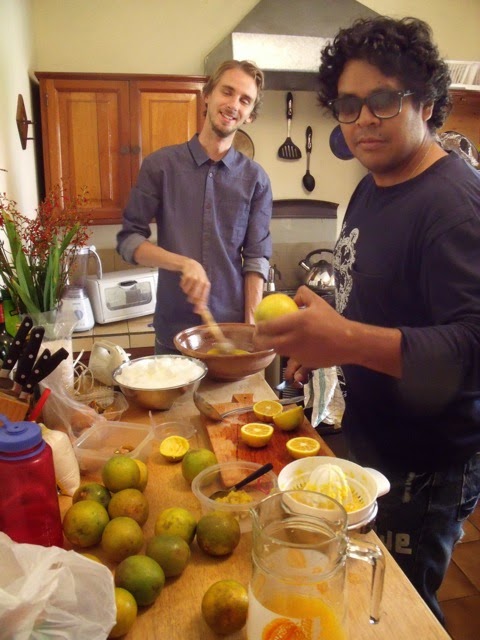
Anders & Christiam making two essential Christmas morning beverages: fresh OJ and homemade eggnog 
Is Andres sleeping? Or playing guitar? Either way, best to be quiet so he has no idea you're taking his photo.
Everyone lingering and making themselves at home
Even cleanup is a party: me and roommate Luciana
What we sometimes call the "dining room" or "living room" our "4th room": the garden.  Home.

Sunday, June 23, 2013

I always miss a few words: the Catholic-Aymara-Gringo World


Last night we walked along the Titicaca lakeshore to the Tocoli schoolhouse. The one-room schoolhouse had been temporarily converted to guesthouse. There we found Katy, Heidi (who both work for a US study abroad program), Calixto, Teresa (a married couple who were the hosts or "guides" for the US students' homestay in this small indigenous village), and a woman everyone soley addressed as "abuela" or "abuelita" ("grandmother").  What Abuelita lacked in teeth she made up for in coca--such a cheekful that even had I spoke Aymara (her only language), I wouldn't have been able to understand a single word she said.  But she cheerfully invited us to 'chupar' coca: an outstretched arm--the language of the body, which I speak.  I learned to say "thank you" and "delicious soup" in Aymara to thank Abuelita for the delicious meal she'd made and shared.  The seven of us sipped soup, sucked coca, and bounced between Spanish, Aymara and English--always returning to Spanish when translation was important.  I have learned to live  in a world where I always miss a few words.  We, both gringos and Bolivians, continued to speak to Abuela in Spanish even though we knew she couldn't understand.  Because that is what human beings do. We try to communicate with whatever tools we have.  "Look up at Heidi, Abuela!" we called. Calixto and his wife translated to Aymara: "Open your eyes when she takes the picture."  Abuela has no experience posing for pictures.  (Is there an Aymara word for "camera"?)

Lighting the Advent candles on our "table" for our Christmas Day Brunch
Calixto is both a Deacon in the Catholic Church and an Aymara Shaman, apparently the only Bolivian uniquely fulfilling both spiritual leadership roles.  In this lakeside indigenous pueblo, I wonder how he connects the two worlds, or if he feels them as separate.  Does he find contradictions? Does he struggle to reconcile beliefs and practices?  I wonder where he sees them agreeing and amplifying one another, where disagreeing and undermining.  I pound he and his wife with questions.  They respond generously, and what's more, offer to hold a ritual ceremony for us on their next trip to Cochabamba.   My mind spins as they share their story, as I connect it back to my own struggle and wondering how this all-encompassing love of God--expressed in God's incarnation, life and death--relates to all the spiritualities around the globe practiced by this species which is "made in God's image."


Where Everything is Measured in Fish and Sunsets


We hike to the next village over, descending to their Titicaca lakeshore pueblo where we encounter a family setting out to fish. "¿Hablan castellaño?"  Yes, they speak some Spanish.   I skip a few rocks with las niñas on the beach while the Viejito and his eldest granddaughter lay nets: a small half moon near the shore, spreading its fabric to hug the fish. Haul it in.  Empty.  No hay ahora.  Espera hasta mañana.

 They offer us a ride back to Tocoli by boat, and though I'm quite sure we could return faster walking, how could we refuse?  With Grandfather and Youngest Granddaughter we set out on the waters of Lago Titicaca at dusk.  We try to make conversation, despite Grandfather being hard of hearing and Youngest Granddaughter's shyness.  Their Spanish carries a heavy Aymara influence--difficult to understand.  Laying five nets for tomorrow's 4:00am fishing, we pass our shoreline tent.  We point it out to Youngest Granddaughter:  "Our casita--inside we have everything we need! A kitchen, living room, cows, sheep, everything!Youngest Granddaughter sizes us up, then cracks a smile.
 We consider offering 10 Bolivianos--about $1.40--as a thank you, but decide against it.  After hearing from Heidi and Calixto about the goals of the village, I sensed that individual payment to this man--however appropriate it seemed to us--would in fact go against what this community was trying to preserve.  Giving money to one man so that he's richer than his neighbors is an occidental, capitalist principal; it is "el mercado" (the market), as the Tocoli community called it in their pueblo meeting. El Mercado of dollars and cents, which is not how things are measured here.


Customer Service, Boredom (and touching the Sun)


 Illampu (Bolivia's 2nd highest at 6.368m/20,892ft) from Lago Titicaca
The high-altitude sun finally peaks around the corner, warming me on my lakeside rock.  So fuerte is her glow at the highest large lake in the world.  Never, it seems, have the clouds been so near--the wide expanse of sky across this enormous lake. Clouds so close to the earth, clouds so close to my hand.  One has a real sense that the rest of the world is beneath us--all around, but farther down.  Farther from the clouds, the sun. This is the top of the world.  
We walk down the lakeside to the one-room schoolhouse where friends share the generous extras of lunch: quinoa soup.  A discussion with Heidi and Katy regarding their university students tiring of discussions on privilege and colonialism: "They 'get it' as an academic topic, yet they complain about 'boring tour guides' at the Casa de la Moneda," completely unconscious of their privilege:  the luxurious upper class privilege of boredom.
A hike near Cochabamba with Becky & Thomas (and
others who weren't pretty enough to make the photo)

As I clocked in over 200 hours of pure travel between Colombia and Bolivia, I couldn't help but admire the great patience of Colombians, Peruvians and Bolivians making their journeys.  I distinctly remember the men (and a few women) simply staring off the port and starboard sides during the 3½ day Amazon journey: never with a face of complaint or boredom—rather a sense that  they "should" be there.  Nor did they fill all their "free" time (which is all 3½ days...what else do you have to do?) with fascinating books, journaling or poker:  a few games, a few conversations, but mostly gazing off the side of the boat.  Almost any Bolivian the age of my friend's American university students would be awed by the Casa de la Moneda in Potosi.  Potosi!  Famous city of silver, violated by the Spanish who sucked enough silver from the bowels of its hills to "build a silver bridge from Potosi to Spain."  I had the privilege of sharing la Casa de la Moneda with a Bolivian friend, fascinated by her homeland's history.  At 31 it was her first visit.  We didn't discuss the tour guide.
La Paz at dusk - looking up at El Alto from the home of a MN-Bolivian friends
During a recent week in La Paz I swung into a shop where I encountered a gringo tourist, a "mochilero", with an open ice cream in hand.  He was attempting, in his non-existent Spanish, to reason with the casera (shopkeeper).  I came upon them, the gringo pointing at his somewhat melted ice cream, and the casera  staring blankly at him, confused.  I stepped in as translator. 
English to Spanish:  "It's melted. It's not good."
Spanish to English:  "It was in the freezer."
English to Spanish:  "Can I exchange it for a different one?"
Spanish to English:  "Yes, you can buy another one."
English to Spanish:  "I can't just exchange it?"
Spanish to Engligh:  "You already opened it."

Gringo to Me:  "But it's kind of melted."
Me to Gringo:  "It's Bolivia."

My first time picking oranges on the trail,
with Gallo & Don Augustín.
I doubt it ever really registered with shopkeeper what the young gringo was requesting. Can she return a half-melted ice cream to the producer?  She must earn 5 Bolivianos off that ice cream: that is survival, that is business.  What do you mean exchange it for another one because it's not good enough? 

I won't scoff at North American excellence and efficiency, nor even its customer service; I miss the hell out of it.  But making melted ice cream and boredom "smaller" is (sometimes) worth it -- to be that much closer to the Sun.
Descending to the Amazon from the Andes in the La Paz province